Research & Public Health Day
Information
Ecosystem
Misinformation
// Where Canadians Get Health Information
per year
The average Canadian sees their doctor about three times a year
// Where Canadians Get Health Information
Top “Alternative Health” Podcasts in Canada

Passion Struck

Feel Better, Live More

Well with Arielle Lorre

Feminist Wellness

Dhru Purohit Show
Dr. Tyna Show

Wellness Process

Dylan Gemelli
mindbodygreen

Dr. Ardis Show

Wise Traditions

Doctor Youn
Not Health Podcasts — But Talk About Health Constantly

Alex Jones

Dana Loesch

Bannon's War Room

Clay & Buck
Joe Rogan

Russell Brand

Flyover Conservatives

Liz Wheeler

Redacted News
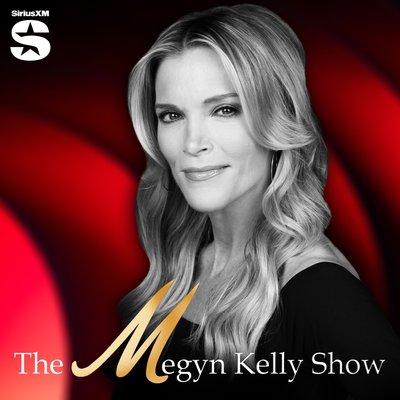
Megyn Kelly

Glenn Beck

Charlie Kirk
// Where Canadians Get Health Information
of Canadians
have turned to AI chatbots for health information
Only 27% trust it to be accurate — but they use it anyway
CMA / Abacus Data, Health and Media Tracking Survey, 2025 (N = 5,000)
What's actually going on?
What is a "healthy" information ecosystem?
Diseased Ecosystem
- Trust driven by identity, not evidence
- Information monocultures
- Misinformation stickier than corrections
- Cascading failure
Healthy Ecosystem
- Trust calibrated to evidence
- Diverse and independent sources
- Corrections propagate
- Resilient to shocks
Rampant health misinformation can be a symptom of a weak information ecosystem.
Studying the ecosystem
- Media Ecosystem Observatory — real-time tracking across 7+ platforms
- Election monitoring & rapid incident response
- Canadian Digital Media Research Network — pan-Canadian partnerships
// The Ecosystem
The health podcast landscape
The health information spectrum
Evidence-Based
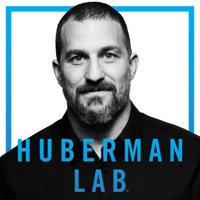 Huberman Lab
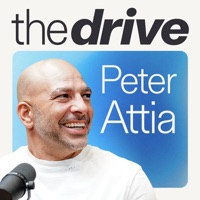 Peter Attia (The Drive)
 BBC Health Check
Functional / Alternative
 Dr. Mark Hyman
 Wellness Mama
- Wise Traditions
Misinformation Vectors
 Dr. Mercola
- Alex Jones
- Bannon's War Room
Political media IS health media
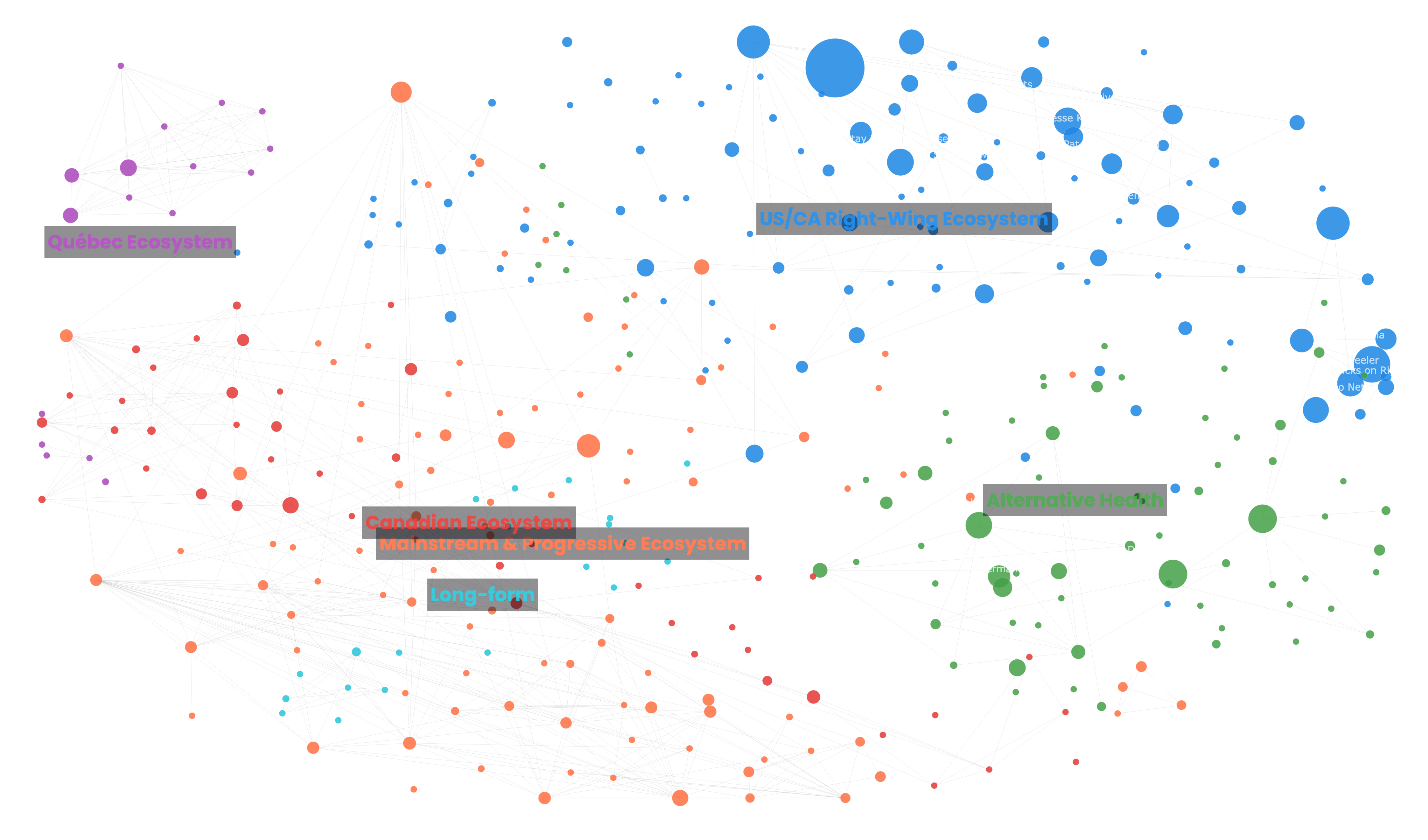
Each node is a podcast channel. Size reflects how often it discusses health topics. Channels are connected when they discuss health in semantically similar ways.
Six ecosystems emerge: the US/CA right-wing political show ecosystem produces the most health content.
Alternative health channels sit adjacent, bridging into political media with larger reach.
363 channels, 51K segments. Louvain clustering, ForceAtlas2 layout.
What they're actually saying
Alex Jones
Jun 30, 2025“Low end, we’re talking like vaccines causing half the autism... a thousand percent increase in autism.”
Megyn Kelly & Dr. Mark Hyman
2025“The toxic stew... mercury or aluminum should also be factored into that discussion. Made perfect sense to me.”
Chronic and acute
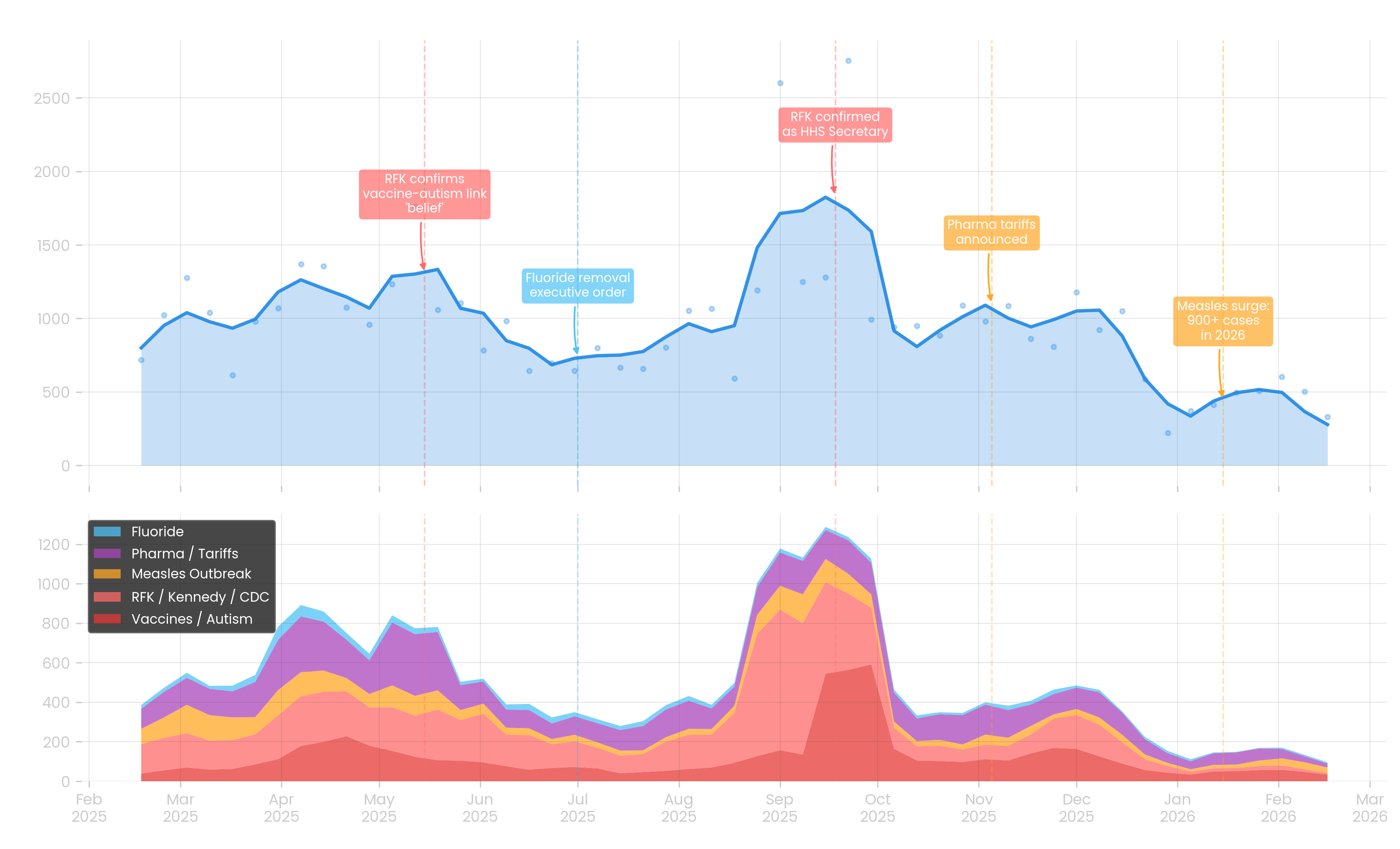
51,302 segments from 613 channels (Feb 2025–Feb 2026). Source: MEO podcast monitoring.
The ecosystem at scale
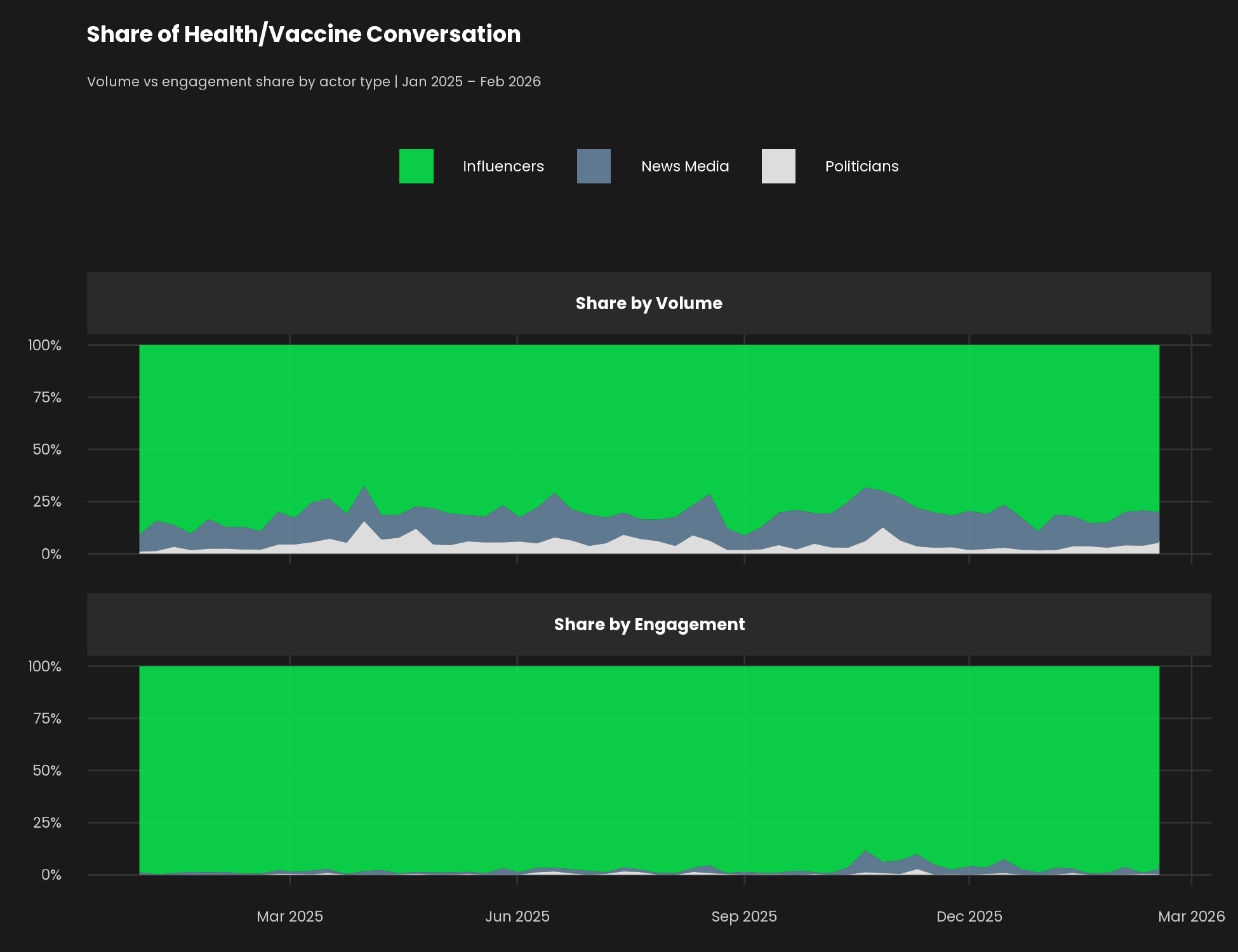
- Misinfo is ~1% of consumption but outsized effects
- Ecosystem is asymmetrically polarized
- Polarization reorganizes social networks
- Fact and expert-based communication has fundamentally changed
What we find in Canada
- Journalism visibility collapse
- Influencers now outpace parties and media in elections
- Foreign actors interested in manipulating Canadian/Western politics (e.g. Tenet Media)
- AI-generated fake Canadian news sites used for grift
The harm is measurable
- COVID-19 misinfo led to lower bound 2,800 excess deaths and $300M in hospital costs in Canada
- Upper limit: one exposure produces -6.4 pp vaccination intent
- Exposure follows health disparities
- AI health advice → 5× more likely to experience harm
Council of Canadian Academies, Fault Lines: Socioeconomic Impacts of Science and Health Misinformation, 2023
Loomba et al., Measuring the Impact of COVID-19 Vaccine Misinformation on Vaccination Intent, 2021
Southwell et al., Misinformation as a Misunderstood Challenge to Public Health, 2023
Roozenbeek et al., Susceptibility to Misinformation about COVID-19 around the World, 2021
CMA / Abacus Data, Health and Media Tracking Survey, 2025
Why is this so hard to fix?
Who owns the conversation?
The conventional wisdom
Just fact check
Effects decay within days and fail to reach the most convinced
Moderate platforms
Vaccine policies were largely ineffective and the algorithmic incentives are simply not there
Teach Media Literacy
Majority of RCTs show no effect and places enormous burden on individuals
The evidence-practice gap
Expert-preferred interventions don't align with the evidence.
What seems to work okay
- Inoculation / prebunking
- Accuracy nudges
- Combination approaches (50-70% more effective)
- Structural factors (83% of variance)
The 🐘 in the room
- Partisanship and strong ideological conviction
- How do you target it in a democracy?
The AI accelerant
Threat Multiplier
- 40M daily health queries to ChatGPT
- Potential to produce personalized misinformation at scale
- Used more and more despite low trust
Potential Tool
- Real-time monitoring
- Prebunking at scale
- Accessible science communication
What can we do?
A public health approach to information
Disease Control
- Vaccination — primary prevention
- Surveillance — track spread
- Treatment — manage infections
- Combination therapy — no single tool works
- Chronic management — ongoing, not one-time
- Acceptable risk thresholds — not zero disease
Information Ecosystem
- Prebunking — inoculate before exposure
- Monitoring — track what's circulating
- Contact and questioning — correct misinformation
- Multi-level intervention — individual + platform + policy
- Sustained effort — effects decay, need boosters
- Tolerable levels of misinfo — resilience, not elimination
What can be done
Communicators
- Fill the vacuum
- Tell visual stories
- Repeat often — effects decay fast
Researchers
- Think about circulation
- Deficiency model is dead
- Your credibility matters
Citizens
- See something, say something
- Friction is your friend
- Diversify your information diet
Professionals
- Structural levers (83%) policy choices
- Demand evidence-based interventions
- Build bridges
// The Treatment
“The information ecosystem is a public health issue. And public health professionals are information ecosystem participants.”
Thank you
Aengus Bridgman: aengus.bridgman@mcgill.ca
Media Ecosystem Observatory: meo.ca
Centre for Media, Technology and Democracy: mediatechdemocracy.com